Couldn't load pickup availability


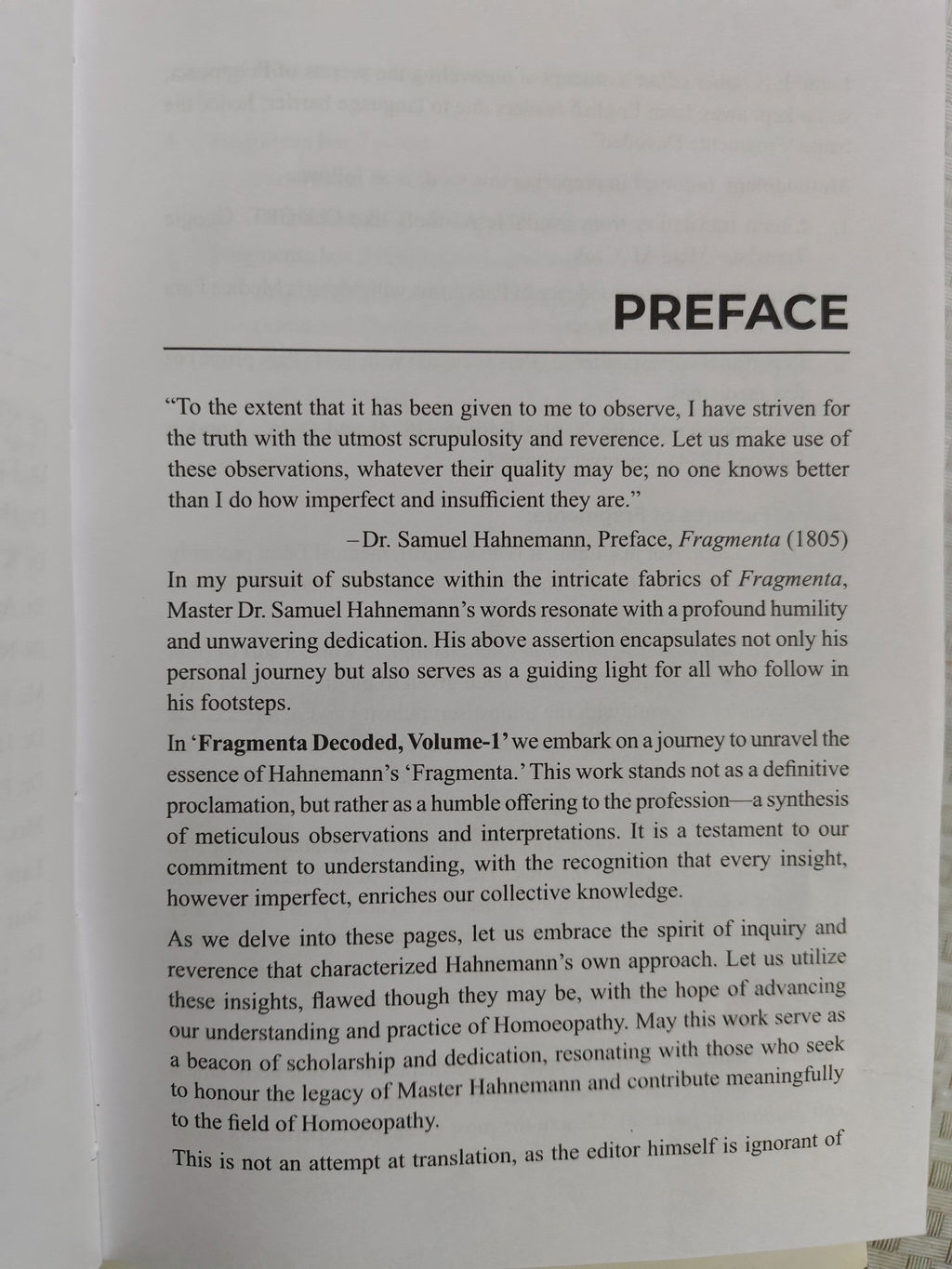
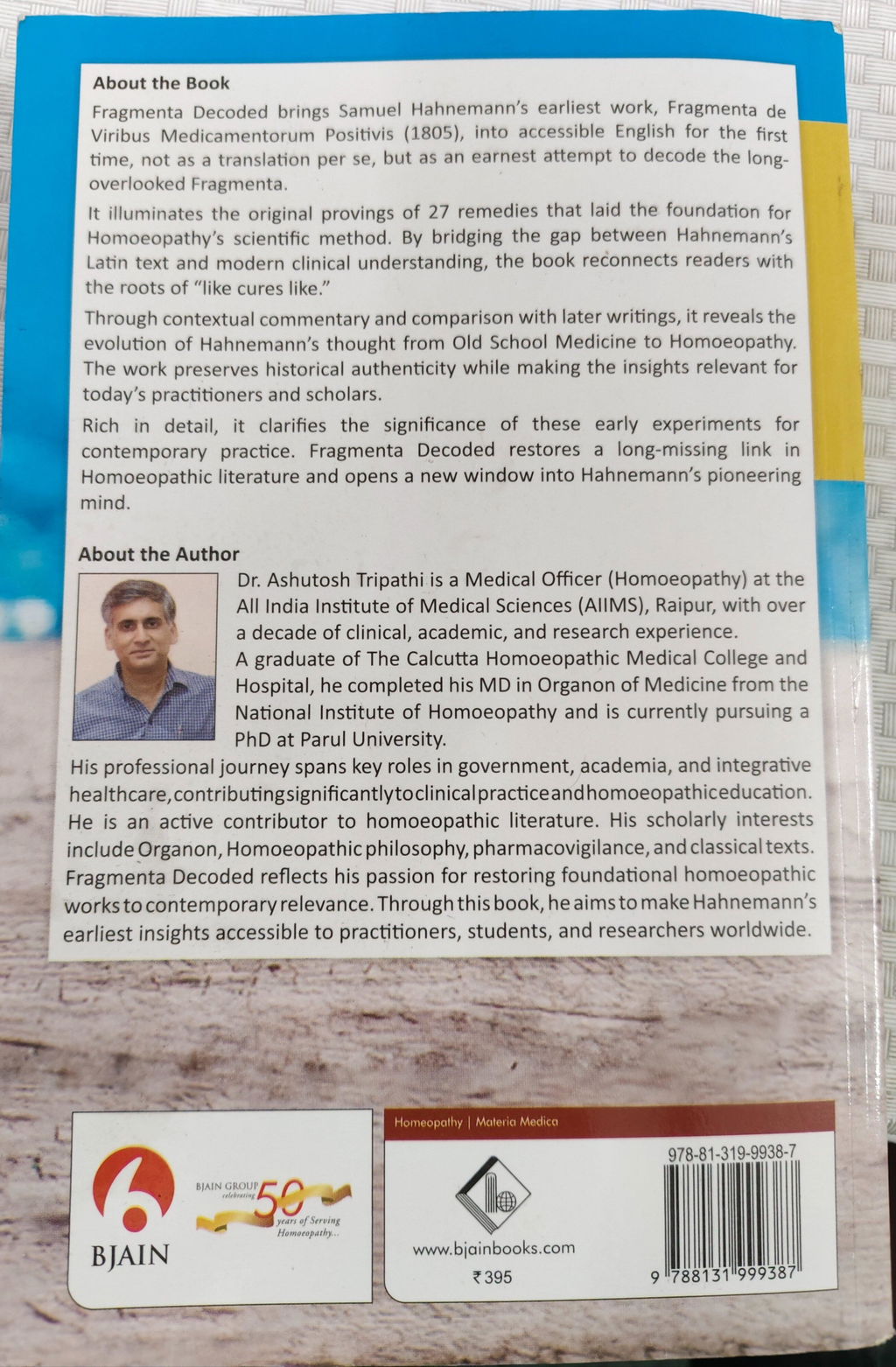
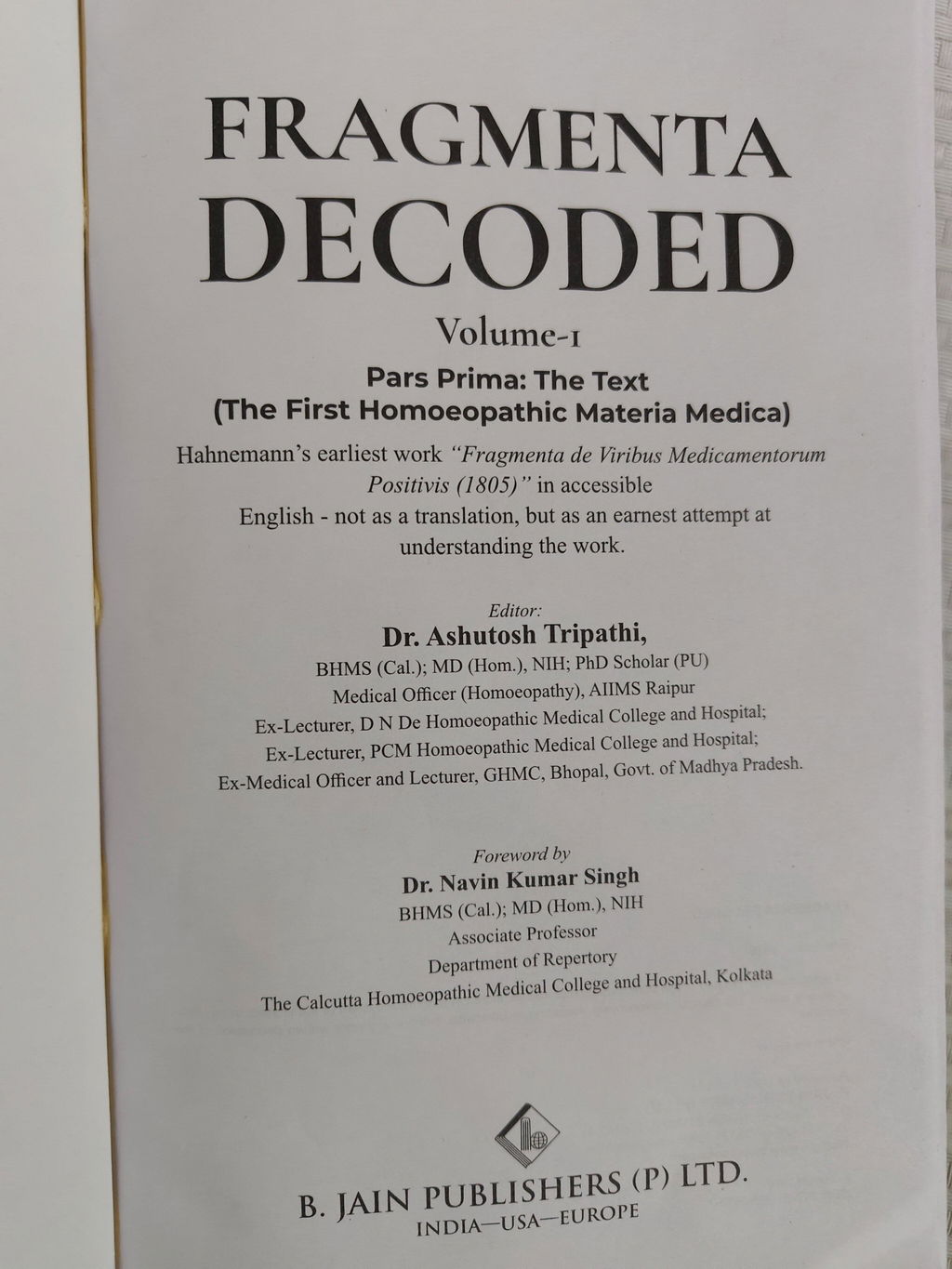
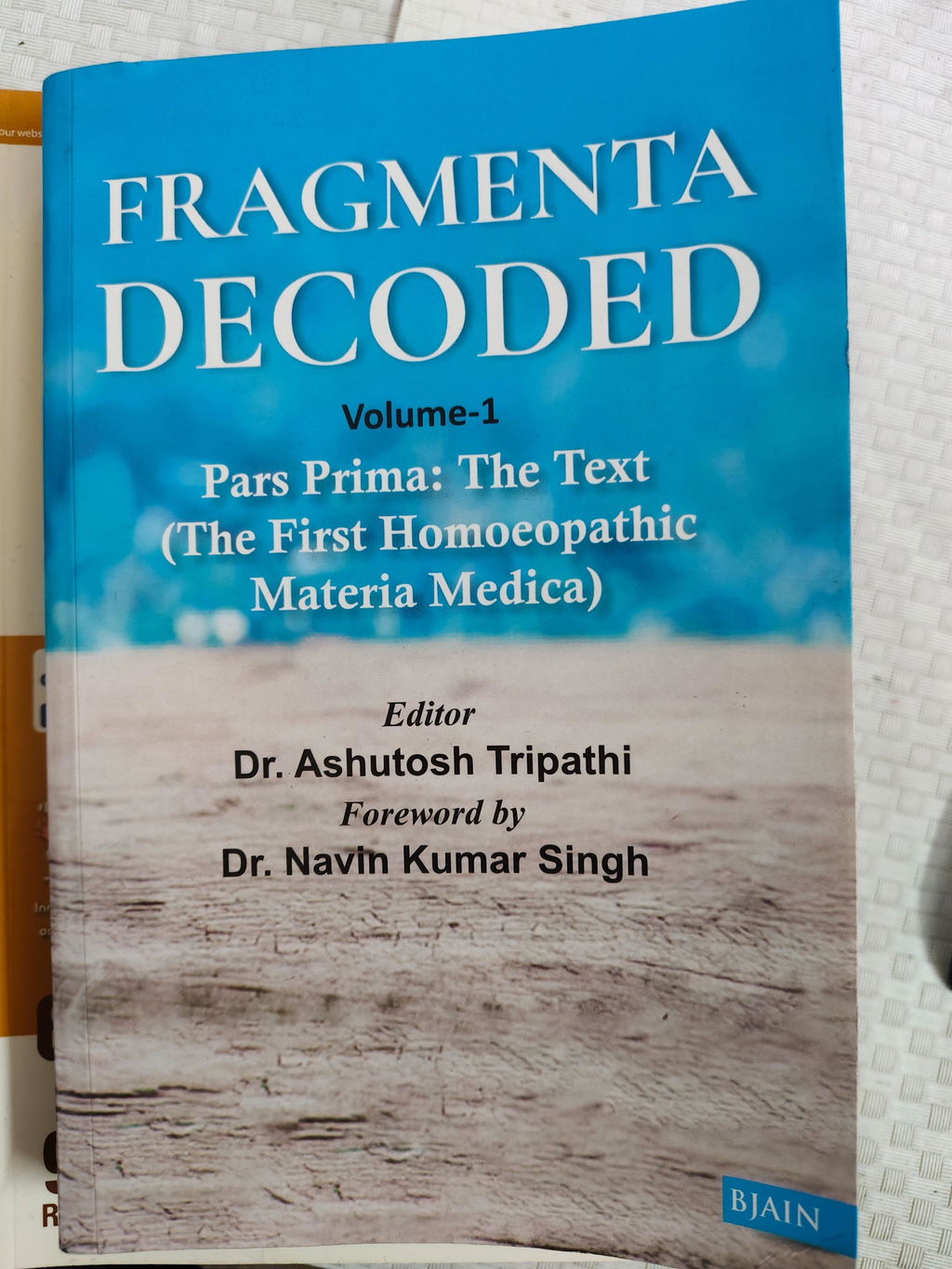
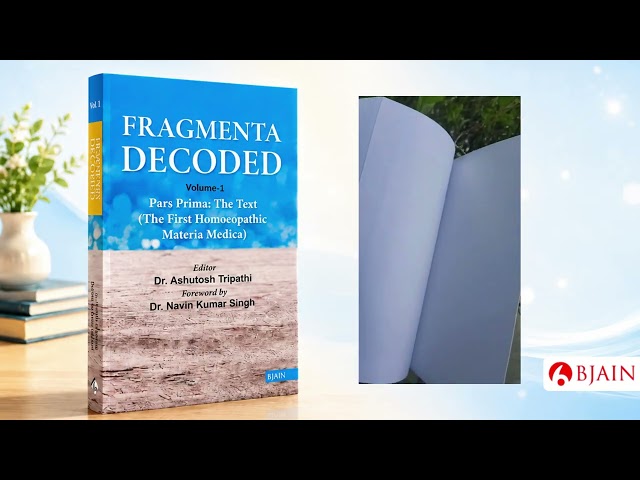
Fragmenta Decoded offers a landmark interpretation of Dr. Samuel Hahnemann’s pioneering work Fragmenta de Viribus Medicamentorum Positivis, recognized as the first homeopathic materia medica. Edited by Dr. Ashutosh Tripathi, a homeopathic medical officer with over a decade of clinical, academic, and research experience, and with a foreword by Dr. Navin Kumar Singh, this edition is a thoughtful and accessible exploration—not a translation—of Hahnemann’s original insights.
The original work, composed in Latin across two volumes (Pars Prima Textus and Pars Secunda Index), details Hahnemann’s drug provings on healthy humans—the foundational methodology of homeopathy. Although several translations exist, none are in English with contemporary relevance. Fragmenta Decoded bridges this gap by presenting Hahnemann’s ideas in a modern, relatable format that illuminates his thought process and methodology.
Harnessing the productive use of artificial intelligence, this edition brings clarity and depth to Hahnemann’s work for today’s learners and practitioners. Highly recommended for BHMS and postgraduate students, Fragmenta Decoded is an essential resource for understanding the original principles that shaped homeopathic practice.
WHAT YOU WILL FIND INSIDE:-
Provings of 27 remedies from Fragmenta are presented, illustrating the roots of the principle of Similia Similibus Curentur.
Each remedy includes a detailed introduction, along with the editor’s commentary explaining how the medicine appears in the original text.
Footnotes from both Dr. Hahnemann and the editor are included for deeper understanding and context.
Accurate page references to the original work are provided throughout.
Symptoms are arranged in the same order as in the original text, along with their documented sources.
An annexure provides information on previous translations of Fragmenta.
Read less.

Ashutosh Tripathi
Customer Reviews
Watch Book Trailer to know more about the book.
Dr. Ashutosh Tripathi deserves sincere appreciation for his dedication to preserving and elucidating one of Homoeopathy's foundational texts. Fragmenta Decoded is not merely a book—it is a bridge connecting Hahnemann's original vision with contemporary Homoeopathic education and practice. It is an essential addition to the library of every Homoeopathic scholar and physician.
The publication of Fragmenta Decoded, the English translation with evolutionary analysis of the pars prima of Fragmenta de Viribus Medicamentorum Positivis, sive in sano corpore humano observatis—Dr. Samuel Hahnemann's first great work on Materia Medica and one of the earliest foundations of the Homoeopathic repertory—is a landmark achievement for the English-speaking Homoeopathic world.
Several of Hahnemann's major works have long been available in English through the dedicated efforts of distinguished translators. Dr. R. E. Dudgeon translated Materia Medica Pura, The Organon of Medicine, and several other important writings, while Prof. L. H. Tafel rendered The Chronic Diseases into English. However, this invaluable early work remained inaccessible to most readers because it was written in Latin. Even after more than 220 years, this language barrier prevented countless students, teachers, practitioners, and researchers from appreciating Hahnemann's earliest scientific observations and tracing the origins and evolution of his Materia Medica.
With Fragmenta Decoded, Dr. Ashutosh Tripathi, a devoted scholar of the Kolkata school of Homoeopathy, has rendered an extraordinary service to the profession. Through painstaking scholarship, meticulous translation, and thoughtful presentation, he has made this priceless treasure accessible to the wider English-speaking Homoeopathic community.
One of the most remarkable features of this work is the lucid presentation of the evolution of Hahnemann's drug pictures—from Fragmenta through Materia Medica Pura to The Chronic Diseases. This enables readers to appreciate the gradual development and refinement of Hahnemann's Materia Medica in its true historical and scientific perspective. Such a comparative and evolutionary approach greatly enhances the reader's understanding of Hahnemann's genius and the progressive maturation of his therapeutic philosophy.
Fragmenta Decoded is far more than a translation; it is a significant scholarly contribution to Homoeopathic literature. It deserves a place in every Homoeopathic library, every medical college, and in the personal collection of every serious student, teacher, practitioner, and researcher of Hahnemannian Homoeopathy. It is a work that no sincere student of the subject should overlook.
Dr. Ashutosh Tripathi has undertaken an exceptionally demanding and painstaking task. His profound knowledge, unwavering dedication, and deep passion for preserving Hahnemann's original writings are reflected on every page of this volume. By removing the language barrier that existed for more than two centuries, he has opened the doors to one of the most important yet least accessible treasures of classical Homoeopathic literature. His achievement deserves recognition and celebration throughout the English-speaking Homoeopathic community.
I extend my heartfelt congratulations and sincere gratitude to Dr. Ashutosh Tripathi for this outstanding contribution to Homoeopathic literature. Fragmenta Decoded is destined to become an indispensable reference for all those who seek to understand the authentic origins and evolution of Hahnemann's Materia Medica.
I also convey my warmest best wishes to Dr. Tripathi for his future literary and scholarly pursuits. May his unwavering commitment to Hahnemannian Homoeopathy continue to enrich our profession with many more path-breaking contributions. I sincerely hope that this remarkable work marks only the beginning of a long and distinguished series of publications that will bring more of Hahnemann's original treasures within the reach of the global Homoeopathic fraternity. May his future works continue to inspire students, teachers, practitioners, and researchers, and further strengthen the foundations of authentic Hahnemannian Homoeopathy for generations to come.
Fragmenta Decoded – Volume I is a valuable contribution to classical homoeopathic literature. It opens access to one of Dr. Samuel Hahnemann's earliest and least accessible works, Fragmenta de Viribus Medicamentorum Positivis (1805), by presenting it in a clear, structured, and reader-friendly format. Rather than replacing the original Latin text, the book serves as an essential companion, guiding readers through Hahnemann's original ideas, historical context, editorial commentary, and the structural framework of the work.